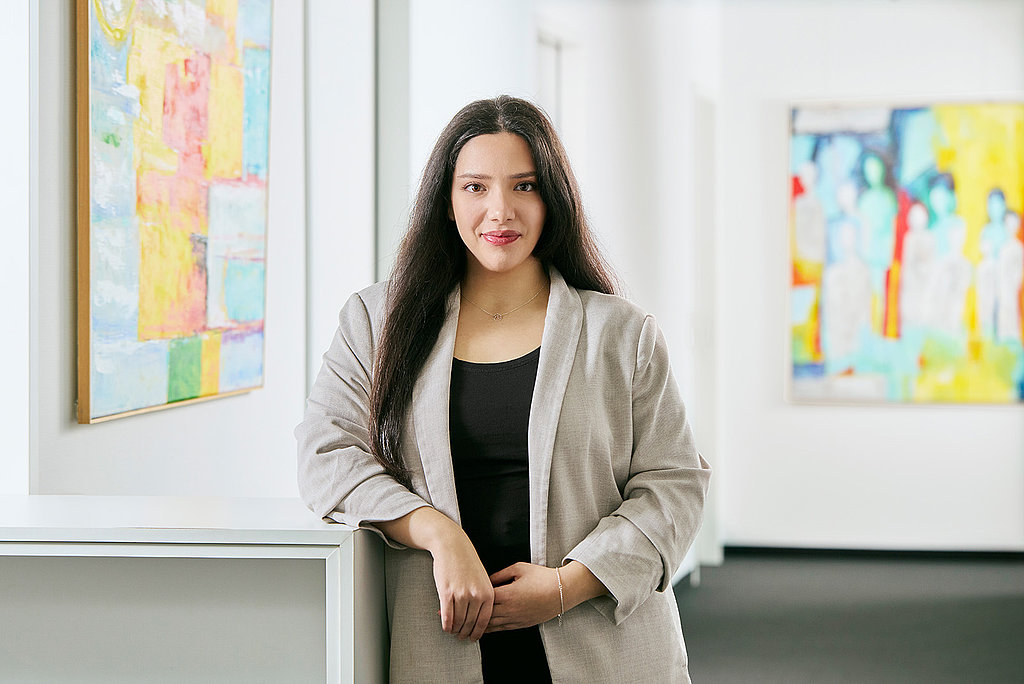
Carl Baker
Senior Manager Treasury, TreasuryHyundai Capital Bank Europe GmbH
close

Christian Bauer is an auditor at KPMG AG in the Financial Services department in Frankfurt am Main. As a partner, he heads Structured Finance and specialises in leasing, factoring and securitisation (synthetic and true sale securitisations). His experience covers audits at banks in Germany and abroad, leasing companies, factoring companies and special purpose vehicles for securitisations. He is a member of working groups at the Institute of Public Auditors in Germany (IDW) and at the Accounting Standards Committee of Germany (ASCG) and is the author of various publications on accounting issues.
close

Julia Donnecker is a legal professional (Ass.iur.) who has been working in the Eligible Assets Section of the Deutsche Bundesbank since 2022. Before that she was working at international law firms and in-house as a banking and finance lawyer for over a decade advising on, inter alia, complex finance transactions. Julia holds a law degree from Goethe University Frankfurt.
close

Jan-Peter Hülbert has been Managing Director of True Sale International GmbH since July 2018. He brings over 20 years of experience in the banking and capital markets business, including 16 years in securitisation on the banking side. Jan-Peter has been responsible for client transactions for banks, corporates and leasing companies in the public ABS, private securitisation and ABCP segments. He holds a degree in business administration from LMU Munich and is a member of the Supervisory Board of STS Verification International GmbH and of the Supervisory Board of European DataWarehouse GmbH. As part of TSIs advocacy activities, he has closely monitored the revision of the European securitisation framework through dialogue with the Commission, the Council and the Parliament.
close

Dr Martin Kaiser, LL.M. is a partner in the finance department and heads the European securitisation team. He specializes in securitisations and focuses on the true sale securitisation of loan, lease and trade receivables, both listed public transactions as well as ABCP programs and bespoke private transactions, e.g. NPLs and start-up and FinTech finance. His expertise also includes aspects of German and European regulatory law related to securitisations. Martin Kaiser advises leading German and international banks, service providers (such as corporate service providers and trustees), leasing companies, car manufacturers and other corporates.
close

Salah has been a Director of STS Verification International GmbH (“SVI”) since July 2021. His areas of responsibility at SVI include the STS verification of ABCP, non-ABCP, and synthetic securitisations across Europe in accordance with the EU Securitisation Regulation. He has extensive experience in the securitisation industry, which he gained from 2011 onwards while working in Deloitte’s Credit & Securitisation Advisory team in Düsseldorf, Germany.
His responsibilities at Deloitte covered trustee and verification services for a wide range of clients in Germany (originators, investors and sponsors) in various synthetic and true sale transactions. As a Senior Manager at Deloitte he was mainly responsible, as the lead manager, for the performance of agreed-upon procedures and credit file due diligences at banks in the context of securitisation and portfolio transactions for consumer, auto and mortgage loans. In addition, he led asset audits of trade receivables within the framework of ABCP programmes. Salah holds a degree (Diploma) in Business Administration from the University of Cologne.
His responsibilities at Deloitte covered trustee and verification services for a wide range of clients in Germany (originators, investors and sponsors) in various synthetic and true sale transactions. As a Senior Manager at Deloitte he was mainly responsible, as the lead manager, for the performance of agreed-upon procedures and credit file due diligences at banks in the context of securitisation and portfolio transactions for consumer, auto and mortgage loans. In addition, he led asset audits of trade receivables within the framework of ABCP programmes. Salah holds a degree (Diploma) in Business Administration from the University of Cologne.
close

Claire-Marie Mallad is a partner partner in the firm's Capital Markets group in Frankfurt practicing in the areas of Debt Capital Markets, Structured Finance and Bank Regulatory laws. Claire-Marie represents financial institutions and investors on a wide range of capital markets transactions with a particular focus on structured finance products, including asset-backed and risk transfer transactions for the purposes of managing a bank’s exposure to credit risk. Furthermore she advises on regulatory capital issuances and advises issuers on the establishment and update of refinancing platforms, including EMTN and CP programmes including advice on regulatory laws and their implications on bank issuers and their creditors.
close

Sebastian Mauersberger ist Associate Director im Bereich Structured Finance EMEA mit Sitz in Frankfurt. Nach seiner Tätigkeit bei Deutsche Bank wechselte er 2021 zu S&P Global Ratings. Er arbeitet an Transaktionen der Anlageklassen ABS, RMBS und ABCP. Sebastian hat einen B.Sc. in Wirtschaftswissenschaften von der Goethe-Universität Frankfurt am Main und einen M.Sc. in Quantitative Economics von der Eberhard Karls Universität Tübingen.
close

Tom Oelrich has been working for DZ BANK AG in Frankfurt am Main in the securitisation department since 2003. As a senior structurer, he has been advising DZ BANK’s clients in all aspects relating to term-ABS capital market transactions since 2015 with a focus on auto-ABS, consumer and SME loans as well as leasing transactions. Previously, Mr. Oelrich arranged ABCP transactions for corporate clients of DZ BANK.
Since entering into the securitisation business, he has structured a large number of customer transactions and has successfully accompanied numerous transactions as placement agent and swap counterparty. Mr. Oelrich has graduated from Frankfurt School of Finance & Management and holds a degree in Business Administration.
Since entering into the securitisation business, he has structured a large number of customer transactions and has successfully accompanied numerous transactions as placement agent and swap counterparty. Mr. Oelrich has graduated from Frankfurt School of Finance & Management and holds a degree in Business Administration.
close

Stefan Rolf is an internationally experienced senior executive in finance and banking with a strong global network. He has a proven track record of building and transforming businesses and driving change. Stefan has deep expertise in corporate treasury, debt capital markets, securitization, and private debt, as well as a focus on sustainable and impact financing solutions. Before founding ROLF Advisory GmbH, Stefan has held various international leadership roles, including Global Head of Securitisation and Private Debt at IQ-EQ, Global Head of Balance Sheet Distribution and Securitisation at ING Wholesale Bank as well as Head of Securitisation and Treasurer of the Asia-Pacific region at Volkswagen Financial Services. Stefan has worked on many ground-breaking and innovative transactions in the global securitisation and structured finance markets, such as first time transactions in China, Turkey and Brazil. He has also done deals across a broad range of asset classes such as auto, consumer lending, SME loans, equipment, infrastructure and sustainability improvement loans and even more esoteric ones. Stefan is a frequent speaker at structured finance/capital markets events in Europe, the US and the Asia- Pacific region, and has worked closely with the European Central Bank, national central banks and various supervisory institutions. He holds an MBA in Economics and is fluent in German and English, with intermediate proficiency in French and Spanish. Stefan is married and has one daughter.
close

Sergej Seiz is Vice President of Asset Securitisation at ING Germany, specializing in auto, consumer, and leasing ABS. He is also actively involved in a working group focused on digital infrastructure securitisation, including Data Center ABS. Sergej joined ING Germany in July 2021 as a Securitisation Manager within the Group Treasury department, where he was responsible for developing ING’s retained ABS/RMBS programme. In 2024, he transitioned to the Asset Securitisation team. Prior to ING, Sergej worked at Moody’s until June 2021, primarily covering new ratings for EMEA ABS/RMBS transactions, later expanding his scope to include CLO and ABCP deals. He holds a Master’s degree in Financial Economics from Maastricht University and is a CFA charterholder.
close

Dr. Christian Thun joined European DataWarehouse GmbH in 2016 as Chief Operating Officer and one year later, was appointed as CEO. Dr Thun worked previously at Moody’s Analytics for 14 years in various senior positions, most recently as senior director with inter alia responsibility for the DACH region. In the early stage of his career, Mr. Thun was a team leader at the risk consulting firm Baetge & Partner (an OliverWyman affiliate) and also worked in structured finance for Dresdner Bank in Frankfurt and London. Christian Thun has published more than 50 articles on topics such as securitisation, risk modelling, stress testing, and data management. He studied business administration and earned his Ph.D. in artificial intelligence at the University of Münster.
close

Bernhard Zahel is a senior portfolio manager with DWS Investment GmbH in Frankfurt am Main, Germany. He is focusing on investments into structured products like Asset Backed Securities as well as illiquid investments such as loans guaranteed by export credit agencies or trade finance receivables. In addition to the management of portfolios his role includes the coverage of certain markets in the respective sectors. In 2014 and 2015 Bernhard was responsible within Deutsche Asset Management for the advisory of the European Central Bank within the ABS Purchase program.
After graduating with a masters degree in economics (Diplom Volkswirt) at University of Bonn, Bernhard started his career in 2001 as a workout analyst for corporate credits with Deutsche Bank AG. From there he joined DWS Investments GmbH in 2004 to become a portfolio manager where he stayed with different responsibilities in various asset classes in fixed income until today.
After graduating with a masters degree in economics (Diplom Volkswirt) at University of Bonn, Bernhard started his career in 2001 as a workout analyst for corporate credits with Deutsche Bank AG. From there he joined DWS Investments GmbH in 2004 to become a portfolio manager where he stayed with different responsibilities in various asset classes in fixed income until today.
close